
Tariff Pressures and Workforce Shifts in Durham Region
Since early 2025, a series of escalating tariffs, initially targeting steel, aluminum, energy, and auto, have reshaped the trade landscape. Since the Trump administration took office, there have been ongoing challenges to trade with the United States. The Canadian Survey on Business Conditions has continued to serve as an important resource for understanding business responses to a changing economic environment.
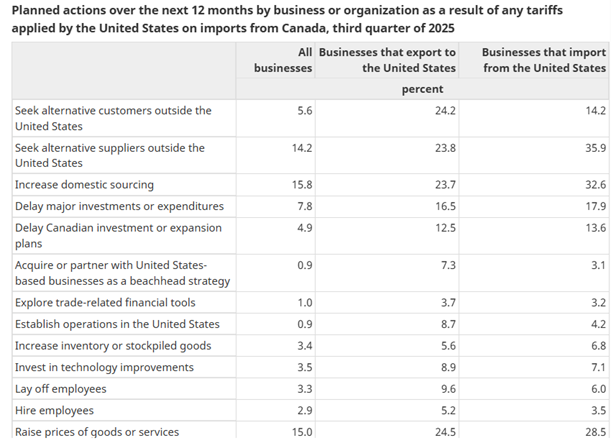
Statistics Canada, Canadian Survey on Business Conditions.
Inisght from the 2026 Durham Employer Survey
The recently completed biennial DWA employer survey asked employers about the impacts of tariffs on local businesses. The employer survey typically collects information on businesses, including, but not limited to, business demographics, industry and business outlook, growth and opportunities, employee attraction and retention, and skillset requirements. Together, these surveys capture local reactions to the tariffs. All businesses, whether engaged in international trade or not, may be affected by disrupted supply chains, increased equipment or parts costs, and decreased market stability. Domestic service providers, such as restaurants and construction businesses, can see shifts in costs, wages, and consumer spending due to tariff-driven economic fluctuations.
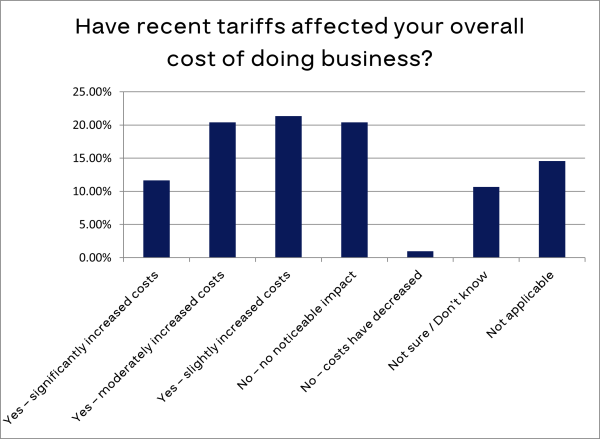
DWA Employer Survey 2026
Tariffs Continue to Pose Labour Market Risks
Industries that make goods and rely on selling to the U.S. are the most at risk right now. In Durham, the DWA is keeping a close eye on manufacturing and related jobs, such as trucking and logistics. Recently, 1,000 workers in Durham’s auto industry were laid off. Across Ontario, many manufacturers are beginning to seek customers outside the U.S. In early 2026, about 12% of manufacturing businesses did this. Other sectors are doing the same, including information and cultural industries (10%) and wholesale trade (5.7%). (Statistics Canada). Ongoing trade tensions and changing policies have created uncertainty. Tariffs and new rules are making it harder for businesses and governments on both sides of the border to plan.
Workforce Tariff Response
To respond to these challenges, the Government of Canada is investing $570 million over three years through the Workforce Tariff Response program. The goal is to help up to 66,000 workers in affected industries. The governments of Canada and Ontario are working together to support workers and strengthen sectors affected by trade issues, tariffs, and global market changes.
One way this support will be delivered is through Ontario’s Skills Advance Ontario (SAO) program. This program brings together employers and training organizations to provide job training and employment support. Skills Advance Ontario helps people find and move into better jobs by offering training for entry-level, mid-level, and higher-skilled roles. It also helps workers learn new skills or upgrade their current ones, while helping employers find and keep skilled workers. In Durham, the Durham Workforce Authority has received SAO funding to help workers who have lost their jobs transition into new opportunities, particularly in the nuclear and healthcare sectors. More details will be shared soon.
About the DWA:
The DWA creates an annual plan supplying helpful information for community planning. Next month, the DWA will release its annual Labour Market Plan (LMP).
The plan focuses on the following:
- Durham Region demographics change, as do migration trends in and out, residents’ educational attainment, and changes in employers in the local area by employee size and 3-digit NAICs.
- Enhanced Jobs First Durham (JFD) data extracted from the DWA’s boutique job board with hyper-local information.
- An update on Employment Ontario data.
The DWA provides just-in-time custom labour market information and often conducts custom fee-for-service research. If you are interested in local data, please don’t hesitate to contact the DWA.
The Province of Ontario partially funds the DWA to supply Labour Market Information (LMI) to the Region of Durham.
Written by: Heather McMillan, Executive Director, Durham Workforce Authority
Heather’s expertise is developing strong local community labour markets and conducting industry research supported by innovative projects. Heather is a Toronto Sector Skills Academy Metcalf Fellow and was recently awarded her Certified Workforce Development Professional (CWDP) certification from the National Association of Workforce Development Professionals.