
Do Fewer Job Post Mean the Economy is Slowing Down?
I recently attended a meeting where a presenter suggested that the economy is slowing because job postings are declining.
Here’s the thing: the relationship between job postings and the economy is complex. Fewer job postings may signal a hiring slowdown, but not necessarily a slow economy. The labour market is influenced by larger external political forces, interest rates and business adjustments. While it is clear that the labour market is facing challenges, job vacancy declines, and slight upticks in unemployment do not directly correlate to an economic slowdown.
Statistics Canada regularly releases the Job Vacancy and Wage Survey by province and economic region. Below is the most recent release, which shows decreases both provincially and by the Toronto Economic Region.
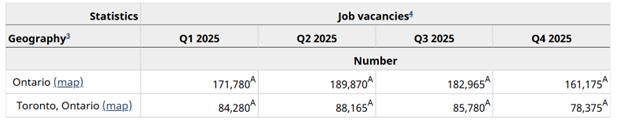
Statistics Canada 14-10-0441-01
The job vacancy rate captures the number of job openings. A higher vacancy rate means employers are having a harder time filling positions, while workers can more easily find a new job. Canada’s job vacancy rate stood at 2.7% in the fall of 2025, down from 3.1% a year earlier. In mid-2021, the rate was near 6%, as the demand for workers surged following the pandemic.
Job losses in some sectors (manufacturing, transportation, and warehousing) were partly due to fears of tariffs and a global trade war emanating from the United States.
Locally, the DWA’s Jobs First Durham (JFD) generates real-time labour market insights using job postings from across Durham Region. By scanning more than 50 of the top employment websites, it captures data on wages, skills, locations, and hiring trends—providing a clear picture of what local employers are looking for and how job seekers are engaging with the market.
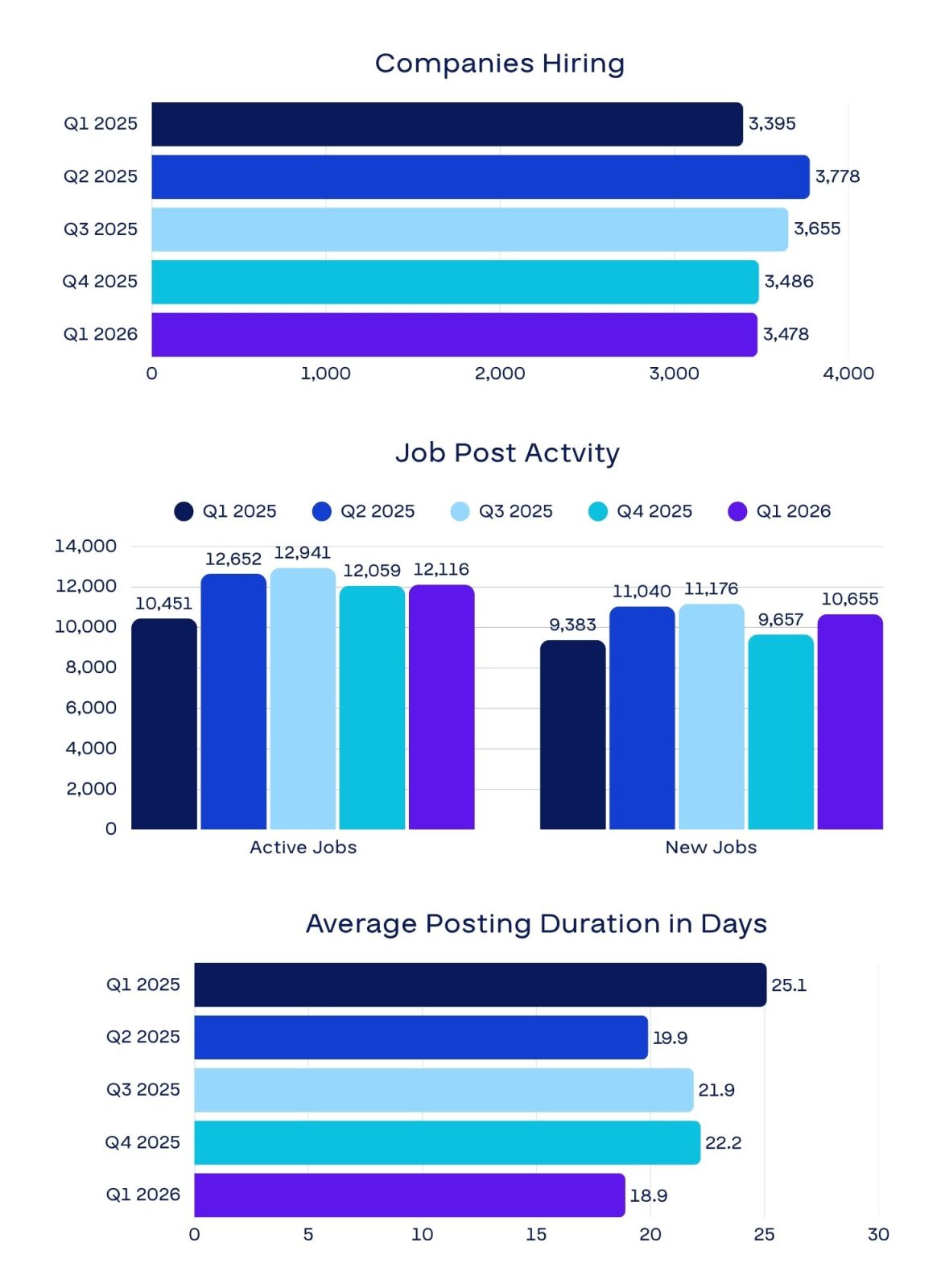
The Q1 2026 Durham Labour Market Insights Report provides a snapshot of employment activity in Durham Region from January to March 2026, highlighting how local hiring conditions changed following the close of 2025. Compared with Q4 2025, overall hiring activity in Q1 2026 remained stable. Active job postings increased slightly from 12,059 to 12,116, while new job postings rose more noticeably from 9,657 to 10,655. At the same time, the number of companies hiring was essentially unchanged, edging from 3,486 to 3,478, and the average posting duration dropped from 18.5 to 18.7 days. Together, these indicators suggest a labour market that remained active at the start of 2026, with modest growth in posting volume but little change in employer breadth or hiring speed
About the DWA:
The DWA creates an annual plan supplying helpful information for community planning. Next month, the DWA will release its annual Labour Market Plan (LMP).
The plan focuses on the following:
- Durham Region demographics change, as do migration trends in and out, residents’ educational attainment, and changes in employers in the local area by employee size and 3-digit NAICs.
- Enhanced Jobs First Durham (JFD) data extracted from the DWA’s boutique job board with hyper-local information.
- An update on Employment Ontario data.
The DWA provides just-in-time custom labour market information and often conducts custom fee-for-service research. If you are interested in local data, please don’t hesitate to contact the DWA.
The Province of Ontario partially funds the DWA to supply Labour Market Information (LMI) to the Region of Durham.
Written by: Heather McMillan, Executive Director, Durham Workforce Authority
Heather’s expertise is developing strong local community labour markets and conducting industry research supported by innovative projects. Heather is a Toronto Sector Skills Academy Metcalf Fellow and was recently awarded her Certified Workforce Development Professional (CWDP) certification from the National Association of Workforce Development Professionals.