
Youth Unemployment Statistics
Youth employment is an essential issue for Canadians. Youth unemployment in Canada is increasing: Young people in Canada are finding it more difficult to find jobs (summer and post-graduate) amid rising competition and a softening labour market.
On average, according to Statistics Canada, youth unemployment nationally tends to be twice the adult unemployment rate (in August, the overall unemployment rate was 9.4%). In other words, if the unemployment rate for a jurisdiction is five percent, the youth unemployment rate should be somewhere between 10 and 12.5 percent.
In addition, unemployment rates can be challenging because Statistics Canada does not make this data available by city. Unemployment rates are available monthly for the census metropolitan area. For Durham, the Oshawa Census Metropolitan Area (CMA) comprises Whitby, Oshawa, and Clarington. Ajax, Pickering, and Uxbridge are part of the Toronto Census Metropolitan Area, which includes the York and Peel regions. Brock and Scugog are statistically too small to be included in Statistics Canada’s monthly surveys. While the Oshawa CMA is used as a proxy for Durham Region, access to CMA-level labour force data, available only in Census years, impacts community planning.
Youth unemployment averaged 18 percent from 2015 until 2025. This aligns with youth unemployment rates from 2010 to 2015. Recently, much discussion has ensued as various community-serving organizations, Employment Ontario service providers, municipal government, federal and provincial ministries, and educational institutions attempt to determine the primary reason(s) for sustained youth unemployment and strive for solutions
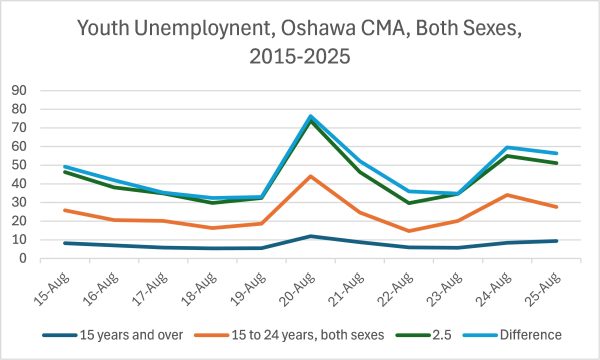
Table: 14-10-0458-01
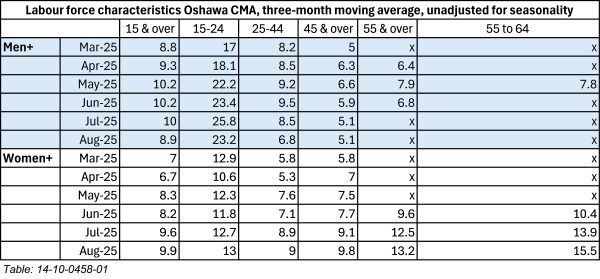
Unemployment is Different by Gender
Unemployment is higher among young men. Unemployment patterns vary across gender and age groups, there are several factors. These include racialized gaps in educational completion, uneven skills development opportunities, and a fragmented institutional support system. Racialized youth unemployment for both sexes is significantly higher, depending on the racialized group. For instance, the South Asian male unemployment rate is 40 percent, and the unemployment rates for Arab and Black women are 28 and 26 percent.
As Ontario and the Durham Region struggle through a shallow recession caused by ongoing economic instability resulting from tariffs, companies are sharply reducing their hiring of entry-level workers. As a result, students and new graduates are grappling to find work. Delayed unemployment impacts productivity, economic prosperity and can lead to so-called labour market scarring as youth struggle to obtain a foothold in the labour market.
Humble Suggestions to Support Youth
- Employer Engagement by Sector to understand job vacancies and engage Employment Services to support labour market attachment
- Encourage youth to leverage Jobs First Durham’s free resources
- Business Education Workshops, Industry Roundtables,
- Create recovery jobs inventory
- Create a Durham Needs You.ca website to promote occupations in demand in the region
About the DWA:
The DWA creates an annual plan supplying helpful information for community planning. Next month, the DWA will release its annual Labour Market Plan (LMP).
The plan focuses on the following:
- Durham Region demographics change, migration trends in and out, educational attainment of residents, and changes in employers in the local area by employee size and 3-digit NAICs.
- Enhanced Jobs First Durham (JFD) data extracted from the DWA’s boutique job board with hyper-local information.
- An update on Employment Ontario data.
The DWA provides just-in-time custom labour market information and often conducts custom fee-for-service research. If you are interested in local data, please don’t hesitate to contact the DWA.
The Province of Ontario partially funds the DWA to supply Labour Market Information (LMI) to the Region of Durham.