
Archive
Tariff Pressures and Workforce Shifts in Durham Region
Leave a CommentSince early 2025, a series of escalating tariffs, initially targeting steel, aluminum, energy, and auto, have reshaped the trade landscape. Since the Trump administration took office, there have been ongoing challenges to trade with the United States. The Canadian Survey on Business Conditions has continued to serve as an important resource for understanding business responses to a changing economic environment.
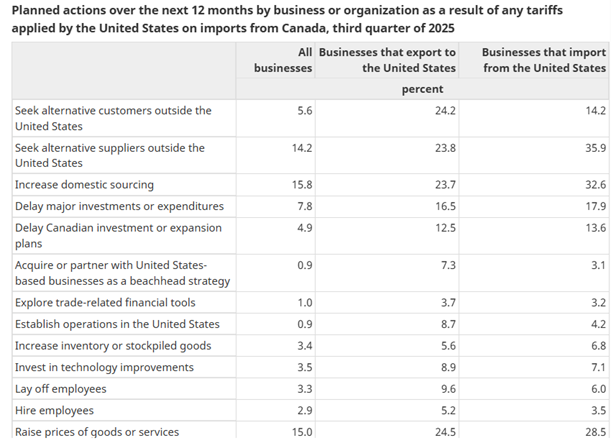
Statistics Canada, Canadian Survey on Business Conditions.
Inisght from the 2026 Durham Employer Survey
The recently completed biennial DWA employer survey asked employers about the impacts of tariffs on local businesses. The employer survey typically collects information on businesses, including, but not limited to, business demographics, industry and business outlook, growth and opportunities, employee attraction and retention, and skillset requirements. Together, these surveys capture local reactions to the tariffs. All businesses, whether engaged in international trade or not, may be affected by disrupted supply chains, increased equipment or parts costs, and decreased market stability. Domestic service providers, such as restaurants and construction businesses, can see shifts in costs, wages, and consumer spending due to tariff-driven economic fluctuations.
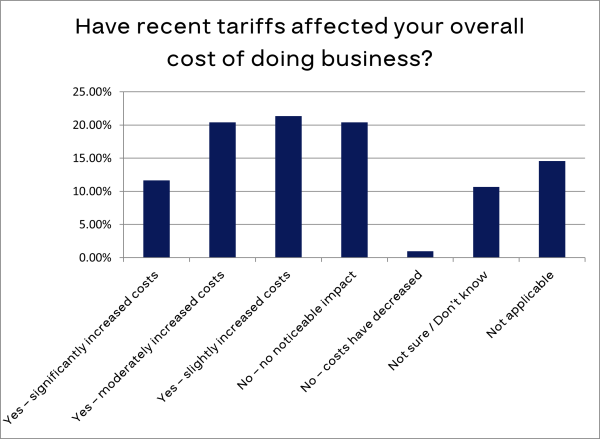
DWA Employer Survey 2026
Tariffs Continue to Pose Labour Market Risks
Industries that make goods and rely on selling to the U.S. are the most at risk right now. In Durham, the DWA is keeping a close eye on manufacturing and related jobs, such as trucking and logistics. Recently, 1,000 workers in Durham’s auto industry were laid off. Across Ontario, many manufacturers are beginning to seek customers outside the U.S. In early 2026, about 12% of manufacturing businesses did this. Other sectors are doing the same, including information and cultural industries (10%) and wholesale trade (5.7%). (Statistics Canada). Ongoing trade tensions and changing policies have created uncertainty. Tariffs and new rules are making it harder for businesses and governments on both sides of the border to plan.
Workforce Tariff Response
To respond to these challenges, the Government of Canada is investing $570 million over three years through the Workforce Tariff Response program. The goal is to help up to 66,000 workers in affected industries. The governments of Canada and Ontario are working together to support workers and strengthen sectors affected by trade issues, tariffs, and global market changes.
One way this support will be delivered is through Ontario’s Skills Advance Ontario (SAO) program. This program brings together employers and training organizations to provide job training and employment support. Skills Advance Ontario helps people find and move into better jobs by offering training for entry-level, mid-level, and higher-skilled roles. It also helps workers learn new skills or upgrade their current ones, while helping employers find and keep skilled workers. In Durham, the Durham Workforce Authority has received SAO funding to help workers who have lost their jobs transition into new opportunities, particularly in the nuclear and healthcare sectors. More details will be shared soon.
About the DWA:
The DWA creates an annual plan supplying helpful information for community planning. Next month, the DWA will release its annual Labour Market Plan (LMP).
The plan focuses on the following:
- Durham Region demographics change, as do migration trends in and out, residents’ educational attainment, and changes in employers in the local area by employee size and 3-digit NAICs.
- Enhanced Jobs First Durham (JFD) data extracted from the DWA’s boutique job board with hyper-local information.
- An update on Employment Ontario data.
The DWA provides just-in-time custom labour market information and often conducts custom fee-for-service research. If you are interested in local data, please don’t hesitate to contact the DWA.
The Province of Ontario partially funds the DWA to supply Labour Market Information (LMI) to the Region of Durham.
Written by: Heather McMillan, Executive Director, Durham Workforce Authority
Heather’s expertise is developing strong local community labour markets and conducting industry research supported by innovative projects. Heather is a Toronto Sector Skills Academy Metcalf Fellow and was recently awarded her Certified Workforce Development Professional (CWDP) certification from the National Association of Workforce Development Professionals.
Do Fewer Job Post Mean the Economy is Slowing Down?
Leave a CommentI recently attended a meeting where a presenter suggested that the economy is slowing because job postings are declining.
Here’s the thing: the relationship between job postings and the economy is complex. Fewer job postings may signal a hiring slowdown, but not necessarily a slow economy. The labour market is influenced by larger external political forces, interest rates and business adjustments. While it is clear that the labour market is facing challenges, job vacancy declines, and slight upticks in unemployment do not directly correlate to an economic slowdown.
Statistics Canada regularly releases the Job Vacancy and Wage Survey by province and economic region. Below is the most recent release, which shows decreases both provincially and by the Toronto Economic Region.
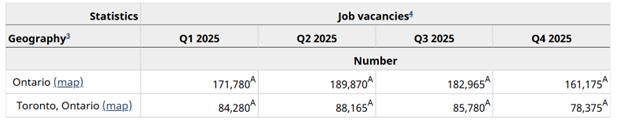
Statistics Canada 14-10-0441-01
The job vacancy rate captures the number of job openings. A higher vacancy rate means employers are having a harder time filling positions, while workers can more easily find a new job. Canada’s job vacancy rate stood at 2.7% in the fall of 2025, down from 3.1% a year earlier. In mid-2021, the rate was near 6%, as the demand for workers surged following the pandemic.
Job losses in some sectors (manufacturing, transportation, and warehousing) were partly due to fears of tariffs and a global trade war emanating from the United States.
Locally, the DWA’s Jobs First Durham (JFD) generates real-time labour market insights using job postings from across Durham Region. By scanning more than 50 of the top employment websites, it captures data on wages, skills, locations, and hiring trends—providing a clear picture of what local employers are looking for and how job seekers are engaging with the market.
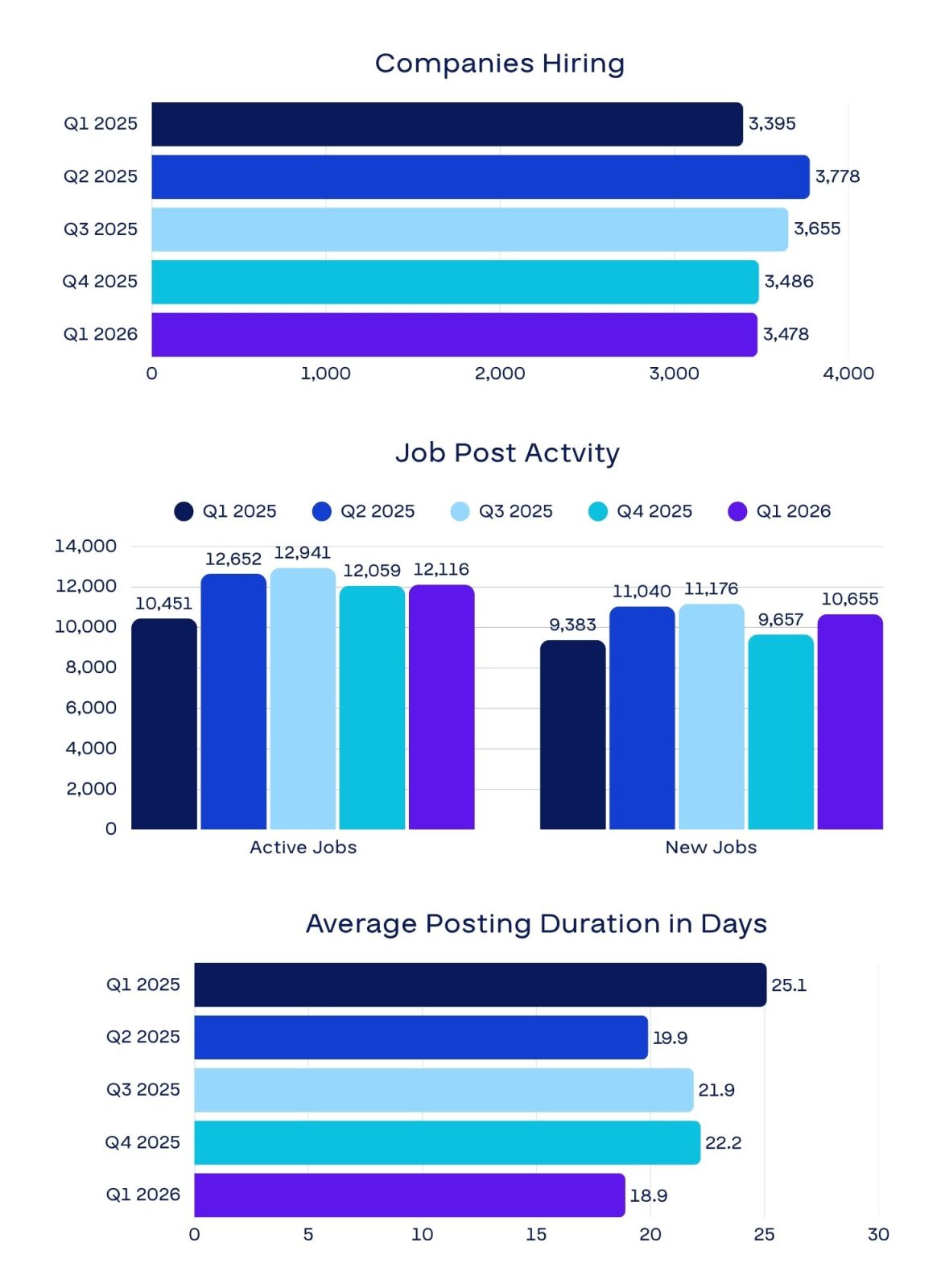
The Q1 2026 Durham Labour Market Insights Report provides a snapshot of employment activity in Durham Region from January to March 2026, highlighting how local hiring conditions changed following the close of 2025. Compared with Q4 2025, overall hiring activity in Q1 2026 remained stable. Active job postings increased slightly from 12,059 to 12,116, while new job postings rose more noticeably from 9,657 to 10,655. At the same time, the number of companies hiring was essentially unchanged, edging from 3,486 to 3,478, and the average posting duration dropped from 18.5 to 18.7 days. Together, these indicators suggest a labour market that remained active at the start of 2026, with modest growth in posting volume but little change in employer breadth or hiring speed
About the DWA:
The DWA creates an annual plan supplying helpful information for community planning. Next month, the DWA will release its annual Labour Market Plan (LMP).
The plan focuses on the following:
- Durham Region demographics change, as do migration trends in and out, residents’ educational attainment, and changes in employers in the local area by employee size and 3-digit NAICs.
- Enhanced Jobs First Durham (JFD) data extracted from the DWA’s boutique job board with hyper-local information.
- An update on Employment Ontario data.
The DWA provides just-in-time custom labour market information and often conducts custom fee-for-service research. If you are interested in local data, please don’t hesitate to contact the DWA.
The Province of Ontario partially funds the DWA to supply Labour Market Information (LMI) to the Region of Durham.
Written by: Heather McMillan, Executive Director, Durham Workforce Authority
Heather’s expertise is developing strong local community labour markets and conducting industry research supported by innovative projects. Heather is a Toronto Sector Skills Academy Metcalf Fellow and was recently awarded her Certified Workforce Development Professional (CWDP) certification from the National Association of Workforce Development Professionals.
Durham Region Poverty Response Steering Committee
Leave a CommentIn May of 2025, the Region of Durham Social Services and Health Departments convened community members to drive an action-oriented response to poverty. This was a continuation of work that began in 2020 but was waylaid by the pandemic. Regional Council directed these departments to establish poverty response efforts.
The first step was a Durham Region Poverty Response Community Workshop. This one-day event brought together community voices, service providers, regional leadership, and people with lived and living experience with poverty.
One important outcome of that meeting was the establishment of a Durham Region Poverty Response Steering Committee of which the DWA Executive Director is a member. In these early days of the committee, the work has focused on building a shared understanding of the issues across the region, aligning with ongoing initiatives and identifying opportunities for action.
Lever of Change
The Poverty Response Steering Committee’s focus is to work through the identified Levers of Change. These levers represent the systems, conditions or barriers that, if addressed, could reduce poverty and improve the quality of life for those experiencing poverty. Levers of Change are key areas where focused action can lead to meaningful improvements. By identifying and working on these Levers, we can target the conditions and root causes of poverty and create more sustainable, community-driven solutions. There may be adjustments to these levers as the steering committee starts its work. Other aspects of levers include physical health, child care, and equity.
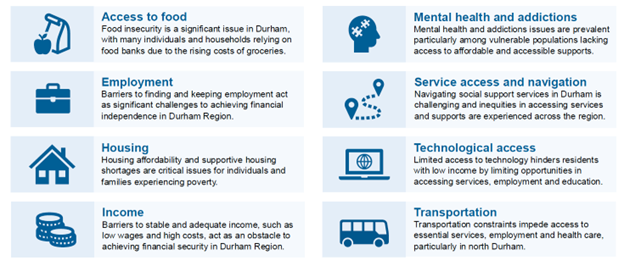
Some of the challenges facing the steering committee:
- Funding and Resource Challenges: Community support organizations face funding challenges, limiting their ability to meet demand and expand services.
- Service access constraints: Residents face challenges accessing supports and services, either due to physical access or through wait times/lists.
- Interconnectedness of Levers: Often, individuals require support across systems, and managing service needs alone can be exhausting.
- Rural access challenges: Rural and north Durham residents have difficulty accessing the same community services and supports that are available in urban centres and south Durham.
These considerations will guide the development of a Poverty Response Program that supports and builds on the work already being done by partners across the region and aligns with the priorities of the Durham Region Strategic Plan and the Community Safety and Well-being Plan.
The DWA will provide updates as the work continues.
About the DWA:
The DWA creates an annual plan supplying helpful information for community planning. Next month, the DWA will release its annual Labour Market Plan (LMP).
The plan focuses on the following:
- Durham Region demographics change, as do migration trends in and out, residents’ educational attainment, and changes in employers in the local area by employee size and 3-digit NAICs.
- Enhanced Jobs First Durham (JFD) data extracted from the DWA’s boutique job board with hyper-local information.
- An update on Employment Ontario data.
The DWA provides just-in-time custom labour market information and often conducts custom fee-for-service research. If you are interested in local data, please don’t hesitate to contact the DWA.
The Province of Ontario partially funds the DWA to supply Labour Market Information (LMI) to the Region of Durham.
Written by: Heather McMillan, Executive Director, Durham Workforce Authority
Heather’s expertise is developing strong local community labour markets and conducting industry research supported by innovative projects. Heather is a Toronto Sector Skills Academy Metcalf Fellow and was recently awarded her Certified Workforce Development Professional (CWDP) certification from the National Association of Workforce Development Professionals.
Behind the Numbers: Labour Market Trends – February 2026
Leave a CommentBehind the Numbers is a monthly series from the Durham Workforce Authority that breaks down the latest labour market data and what it means for Durham Region. This blog is informed by the February 2026 Employment by Industry Report and Labour Force Survey Report. In February 2026, Durham Region’s labour market showed stable growth alongside emerging pressures, with sector-level changes and labour force shifts shaping overall conditions. This snapshot highlights what’s changing, and what it means for employers, jobseekers, and workforce planning across the region
Key Highlights
- Employment: 254,100, a decrease of 1,700 month-over-month but an increase of 7,400 year-over-year
- Unemployment: 20,300 an increase of 500 month-over-month
- Participation Rate: 67.3% , a drop of 0.5%
- Population: 407,500
- Major sector shifts across retail, health care, and professional services
What’s Happening in the Labour Market
February reflects a labour market that is adjusting after a period of stronger growth, with several key indicators moving in different directions. Employment declined slightly, unemployment increased, and participation dropped, indicating a modest shift in overall labour market conditions. While these changes are not large, they suggest that the pace of growth seen in late 2025 has begun to ease.
At the same time, the labour market remains stable overall, with employment levels still higher than one year ago and no evidence of widespread decline across the labour market. Sector-level data helps explain the broader labour force trends observed in February. This indicates that Durham’s labour market is stabilizing rather than weakening, with short-term pressures emerging within a still-growing system.
- Growth in health care and trades is helping to sustain overall employment levels
- Declines in retail and professional services are contributing to rising unemployment
- Participation declines suggest changes in workforce engagement
These dynamics highlight the interconnected nature of labour market indicators. Changes in sector demand can influence employment levels, which in turn affect unemployment and participation rates.
For example, job losses in large sectors such as retail can have a noticeable impact on overall unemployment, while growth in specialized sectors may not fully offset those losses if the required skills differ.
A Closer Look at What’s Driving Change
Sector-level trends provide important context for understanding the broader labour force shifts.
Growth in health care and skilled trades continues to support overall employment levels, reflecting sustained demand tied to population growth and service delivery. At the same time, declines in large sectors such as wholesale and retail trade and professional services are contributing to rising unemployment. This dynamic highlights an important structural reality: not all job losses and job gains are interchangeable. Workers displaced from one sector may not immediately transition into another, particularly where skills, experience, or qualifications differ. Participation trends add another layer to this picture. The decline in participation suggests that some individuals are stepping out of the labour force entirely, whether due to education, caregiving responsibilities, or challenges in finding suitable employment.
Together, these factors point to a labour market that is not contracting, but becoming more complex—where growth, displacement, and disengagement can occur at the same time.
Looking Beyond the Month-to-Month Changes
While monthly changes provide useful signals, longer-term trends offer a clearer view of labour market health. Over the past year, employment has increased, supported by steady population growth and expanding labour supply. Over a two-year period, employment gains have been even more pronounced, reflecting a region that continues to grow and attract workers.
Population growth remains a key driver. As more individuals enter Durham Region, both labour supply and demand increase. This contributes to rising employment levels, but can also result in higher unemployment as more individuals actively participate in the job market. This reinforces a key insight: rising unemployment in a growing region does not necessarily indicate decline, it can reflect increased participation and labour market expansion.
What This Means for Employers and Jobseekers
For employers:
While labour supply is increasing, sector-specific pressures remain. Employers in high-demand sectors, particularly health care, construction, and logistics, may need to adapt recruitment strategies, including wages, scheduling flexibility, and training pathways, to remain competitive. At the same time, employers in sectors experiencing decline may have greater access to available talent.
For jobseekers:
Opportunities remain strongest in sectors experiencing sustained growth, particularly those tied to essential services and infrastructure. However, jobseekers in sectors facing contraction may encounter increased competition and may need to consider reskilling or transitioning into in-demand fields.
The current labour market is not defined by a lack of opportunity, but by where those opportunities are concentrated.
Looking Ahead
Durham Region’s labour market will continue to be shaped by the interaction between population growth, sector demand, and workforce participation.
Monitoring how these factors evolve, particularly participation levels and sector-specific employment trends, will be critical in determining whether current pressures are temporary or indicative of longer-term shifts. Understanding these dynamics will be key to aligning workforce strategies with where the labour market is heading, not just where it has been.
The Durham Workforce Authority will continue to track and share these insights to support informed decision-making across the region.
Behind the Numbers: Labour Force Overview – February 2026
Leave a CommentBehind the Numbers is a monthly series from the Durham Workforce Authority that breaks down the latest labour market data and what it means for Durham Region. This blog is informed by the February 2026 Labour Force Survey Report, which can be found here.
In February 2026, Durham Region’s labour market showed stable overall conditions with slight softening, including a decline in employment and participation alongside a modest increase in unemployment.
Key Highlights
- Labour Force: 274,300, down 1,300 month-over-month
- Employment: 254,100, down 1,700
- Unemployment: 20,300, up 500
- Unemployment Rate: 7.4%, increased by 0.2%
- Participation Rate: 67.3%, dropped 0.5%
What’s Happening in the Labour Market
February’s data reflects a modest cooling in labour market activity, with fewer individuals employed and more actively seeking work. While these changes are relatively small, they represent a shift from the stronger labour market conditions observed in late 2025. The simultaneous decline in employment and rise in unemployment suggests that hiring activity has slowed in the short term. However, these movements remain within the range of normal month-to-month variation and should be interpreted within the context of broader trends.
Importantly, employment levels remain higher than they were one year ago, indicating that the labour market continues to operate from a position of relative strength. This suggests that Durham’s labour market is stabilizing after a period of growth, rather than entering a period of decline.
Participation, Employment, and Unemployment Trends
The relationship between participation, employment, and unemployment provides important insight into overall labour market dynamics. In February:
- Employment decreased
- Unemployment increased
- Participation declined
At the same time, the number of individuals not participating in the labour force increased, indicating that more residents are neither working nor actively seeking work. This combination points to a shift in workforce engagement. Some individuals may be exiting the labour force due to factors such as education, caregiving responsibilities, or challenges in finding suitable employment, while others remain active in their job search without securing employment. These dynamics highlight the importance of looking beyond a single indicator. For example, rising unemployment can reflect both increased job search activity and challenges in matching workers to available roles.
Taken together, these trends indicate that labour supply is adjusting, with changes occurring in both participation and employment at the same time.
Looking Beyond the Month-to-Month Changes
While monthly fluctuations provide useful signals, longer-term trends offer a more comprehensive view of labour market conditions.
Over the past year:
- Employment increased by 7,400
- Unemployment increased by 900
- Not participating increased by 3,100
Over a two-year period, employment has grown significantly, reflecting a larger and more active labour market overall. Trend data (pages 3–5) shows that employment and participation rates peaked in late 2025 before easing into early 2026. This pattern suggests that recent changes may represent a normalization following a period of stronger labour market performance. Population growth continues to play a key role in shaping these trends, increasing both labour supply and the number of individuals entering or re-entering the workforce.
This reinforces an important point: short-term increases in unemployment can occur even in a growing labour market, particularly when labour supply is expanding.
What This Means for Employers and Jobseekers
For employers:
A growing labour force provides access to a broader pool of potential workers. However, declining participation may signal challenges in workforce engagement, particularly among individuals who are not actively seeking employment. Employers may need to consider strategies to attract underrepresented groups, improve job quality, or provide more flexible work arrangements to strengthen participation.
For jobseekers:
While opportunities remain available, the increase in unemployment suggests that competition for jobs may be intensifying, particularly in sectors experiencing slower growth. Jobseekers may benefit from focusing on in-demand skills or exploring opportunities in sectors that continue to expand.
The current labour market reflects a balance between opportunity and competition, shaped by both demand for workers and the number of individuals seeking employment.
Looking Ahead
Labour force participation will be a key indicator to monitor in the coming months, as it reflects how actively residents are engaging with the labour market. Changes in participation can have a significant impact on both employment and unemployment trends, making it an important signal for understanding the direction of the labour market. Sustained shifts in participation will help determine whether recent changes represent a temporary adjustment or a longer-term change in workforce engagement.
The Durham Workforce Authority will continue to track and share these insights to support informed decision-making across the region.
Behind the Numbers: Employment by Industry – February 2026
Leave a CommentBehind the Numbers is a monthly series from the Durham Workforce Authority that breaks down the latest labour market data and what it means for Durham Region. This blog is informed by the February 2026 Employment by Industry Report, which can be found here.
In February 2026, Durham Region’s labour market showed continued sector-level shifts, with growth in health care and several public-facing industries, alongside declines in retail and professional services. This snapshot highlights what’s changing, and what it means for employers, jobseekers, and workforce planning across the region.
Key Highlights
- Employment: 254,100, down 1,700 month-over-month
- Health Care & Social Assistance: 39,800, up 13,600 year-over-year
- Wholesale & Retail Trade: 30,400, down 7,300 year-over-year
- Manufacturing: 18,700, up 3,000 year-over-year
- Professional Services: 21,600, down 6,600 year-over-year
What’s Happening in the Labour Market
Employment declined slightly in February, reflecting typical month-to-month variation following stronger gains in late 2025. While this decrease is notable, it does not indicate a broad-based decline in labour market conditions. Instead, the data points to a labour market that is adjusting, with gains in some sectors offsetting losses in others. This type of movement is common in a growing and evolving economy, particularly as industries respond to changes in demand, investment, and workforce availability.
Importantly, overall employment levels remain higher than they were one year ago, reinforcing the underlying strength of the labour market. This suggests that Durham’s labour market is not weakening, but rebalancing as sector demand shifts.
Sector-Level Trends Across Durham Region
A closer look at industry-level data reveals a labour market increasingly shaped by population growth, service demand, and infrastructure investment.
Sectors experiencing growth include:
- Health Care & Social Assistance
- Manufacturing
- Transportation & Warehousing
- Educational Services
- Construction
The expansion of health care continues to be a defining feature of the local labour market, reflecting sustained demand for services in a growing region. Similarly, gains in construction and education suggest ongoing investment in both physical infrastructure and community services. Growth in manufacturing and transportation points to continued strength in goods movement and supply chain activity, reinforcing Durham Region’s role within the broader regional economy.
At the same time, some of Durham’s largest employment sectors are experiencing contraction.
Sectors experiencing decline include:
- Wholesale & Retail Trade
- Professional, Scientific & Technical Services
- Accommodation & Food Services
Declines in retail may reflect evolving consumer behaviour and broader economic pressures, while decreases in professional services could indicate shifts in business investment, project cycles, or organizational restructuring. Accommodation and food services, which are closely tied to discretionary spending, continue to show variability.
These trends highlight a key structural shift: employment growth is increasingly concentrated in essential and infrastructure-related sectors, while consumer-driven and knowledge-based sectors face greater volatility.
Looking Beyond the Month-to-Month Changes
While monthly changes provide useful insight, longer-term trends offer a more complete picture of labour market conditions. Over the past year, employment has increased across the region, even as individual sectors have experienced periods of growth and decline. The trend data (page 2) shows relatively stable overall employment levels, with fluctuations occurring within industries rather than across the labour market as a whole.
This pattern reflects a labour market that is adapting to changing economic conditions, rather than experiencing widespread contraction. In this context, sector-level volatility is not a sign of instability, but an indicator of a labour market in transition.
What This Means for Employers and Jobseekers
For employers:
Employers in high-growth sectors, particularly health care, construction, and logistics, may continue to face recruitment pressures as demand for workers remains strong. Addressing these challenges may require a focus on workforce development, training pathways, and retention strategies. At the same time, employers in sectors experiencing decline may benefit from a larger pool of available workers, particularly those with transferable skills from retail and professional services.
For jobseekers:
Jobseekers may find the strongest opportunities in sectors experiencing sustained growth, particularly those tied to essential services and skilled trades. However, individuals seeking employment in sectors facing contraction may encounter increased competition and may need to consider reskilling or transitioning into in-demand fields.
The current labour market is defined less by a lack of jobs, and more by where those jobs are concentrated.
Looking Ahead
As Durham Region continues to grow, sector-level trends will remain a critical component of labour market analysis. Monitoring how employment shifts across industries, particularly in response to population growth and economic conditions, will be key to understanding where future opportunities and challenges may emerge. Aligning workforce strategies with these sector trends will be essential to ensuring that both employers and jobseekers can successfully navigate a changing labour market.
The Durham Workforce Authority will continue to track and share these insights to support informed decision-making across the region.
Wages, Skills, and Job Quality: What 2025 JFD Data Tells Us About Work in Durham
Leave a CommentWage and skill data from 2025 highlights both progress and ongoing challenges in Durham Region’s labour market. While wages continued to rise modestly, improvements in job quality remained uneven across sectors and occupations.
The average posted hourly wage increased to $27.85, with the median wage rising to $23.27. Wage growth was strongest in utilities and technical occupations, reflecting increased demand for specialized skills. Health professions, natural and applied sciences, and senior management roles continued to command the highest wages overall.
Despite these gains, many high-volume roles—particularly in retail, food services, and administrative support—remained lower-wage. This reinforces a persistent divide between job accessibility and job quality, with many jobs easy to enter but offering limited wage progression.
Skill requirements remained consistent across the year. Employers most frequently sought communication, customer service, management, interpersonal, and organizational skills, emphasizing transferable competencies over formal credentials. More than 80% of job postings did not specify education or experience requirements, which supports broad workforce access but increases reliance on on-the-job learning.
Strengthening pathways from accessible entry-level work into higher-skill, higher-wage roles remains a key opportunity for Durham’s workforce system.
These insights are drawn from the Durham Workforce Authority’s 2025 Annual Labour Market Insights Report, which provides a comprehensive overview of hiring activity, wages, skills demand, and jobseeker behaviour across Durham Region. Read the full report to explore the data in more detail.
Where the Jobs Were in 2025: Sector and Occupational Shifts in Durham Region
Leave a CommentHiring demand in Durham Region during 2025 became increasingly concentrated in essential services, care-based roles, and infrastructure-related occupations, reflecting broader demographic and economic pressures.
The health care and social assistance sector remained the largest source of job postings throughout the year, driven by aging demographics and sustained demand for care services. Retail trade continued to generate a high volume of postings, though ongoing declines suggest persistent turnover rather than expansion. Meanwhile, administrative and support services experienced a notable contraction, indicating longer-term shifts in staffing models and automation.
One of the most significant shifts in 2025 was the rise of utilities as the fastest-growing sector, increasing by 25% year over year. While smaller overall, this growth reflects increased demand for skilled, technical, and infrastructure-supporting roles in energy and public services.
Occupational trends mirrored these sectoral shifts. Retail salespersons, food counter attendants, and cooks remained among the most frequently posted roles, continuing to provide key entry points into the labour market. At the same time, demand for home support workers and caregivers remained strong, underscoring the structural nature of care-related labour needs in Durham.
These trends suggest that while entry-level service roles remain critical, long-term growth is increasingly linked to skilled, technical, and care-focused occupations.
These insights are drawn from the Durham Workforce Authority’s 2025 Annual Labour Market Insights Report, which provides a comprehensive overview of hiring activity, wages, skills demand, and jobseeker behaviour across Durham Region. Read the full report to explore the data in more detail.
Durham’s Labour Market in 2025
Leave a CommentThe 2025 labour market in Durham Region reflects a year of adjustment rather than decline. While overall job posting volumes moderated compared to 2024, hiring activity remained steady and responsive, pointing to a labour market that continues to efficiently absorb available workers.
Throughout 2025, employers posted 42,328 active job postings, supported by 7,329 unique employers hiring across the region. Although this represents a decrease from the previous year, the average job posting duration fell sharply to 17.6 days, down from over 28 days in 2024. This faster fill time suggests improved alignment between employer needs and available labour, even as hiring became more selective.
At the same time, jobseeker engagement increased significantly, with total interactions across Jobs First Durham tools rising to 147,317, a 30% year-over-year increase. This indicates an active workforce navigating a competitive labour market, rather than disengagement.
Taken together, the data show a labour market that remains resilient. Employers are hiring more strategically, jobseekers are more actively engaged, and hiring efficiency has improved, key signals that the system is adapting to economic moderation while maintaining momentum.
These insights are drawn from the Durham Workforce Authority’s 2025 Annual Labour Market Insights Report, which provides a comprehensive overview of hiring activity, wages, skills demand, and jobseeker behaviour across Durham Region. Read the full report to explore the data in more detail.
Durham Workforce Authority Joins The Canadian Queer Chamber of Commerce
Leave a CommentThe Durham Workforce Authority is excited to share that we have joined the Canadian Queer Chamber of Commerce (CQCC), a national organization that advances inclusive economic participation for 2SLGBTQI+ entrepreneurs, professionals, and organizations across Canada.
This membership reflects DWA’s ongoing commitment to equity, diversity, and inclusion (EDI). It will enhance our ability to ensure that local labour market information, partnerships, and economic development supports are as accessible and representative as possible. It also strengthens our connections with partners and networks that champion inclusive economic participation for all.
As a small, publicly funded organization, the DWA is deliberate about how we allocate our limited financial resources. Memberships, partnerships, and affiliations are chosen carefully, with a focus on organizations whose mandates align with our values and advance our mission to support a fair, inclusive, and evidence-based labour market.
Joining CQCC’s resources network reflects this approach. It is not simply a symbolic affiliation but a strategic decision to connect with a national network that supports economic inclusion and amplifies the voices of historically underrepresented groups in the workforce. This aligns with our broader labour market and workforce development priorities. In particular, it supports our focus on improving access to meaningful employment and business supports, and strengthening the inclusivity and relevance of labour market information in Durham Region.
Grounded in Community Consultation and Research Strategy
DWA’s decision to strengthen its connection with the CQCC is directly informed by our revised Research Strategy, which was shaped through extensive community consultations across Durham Region.
Through these consultations, community partners, service providers, and residents emphasized the importance of ensuring that labour market research reflects the lived experiences of diverse communities, including groups that are often underrepresented or invisible in traditional data sources. This feedback reinforced the need for the DWA to:
- Broaden the range of voices informing our labour market analysis
- Strengthen relationships with organizations embedded in equity-seeking communities
- Ensure our data and insights better reflect the full diversity of Durham’s workforce
Our updated research strategy committed the DWA to embedding equity, inclusion, and community-informed perspectives into how we collect, analyze, and share labour market information. Closer collaboration with networks such as CQCC embodies that mandate.
Strengthening Inclusive Workforce Development in Durham Region
The CQCC supports a national ecosystem of 2SLGBTQI+ businesses and allied organizations by providing access to resources, networks, and thought leadership focused on inclusive economic growth. Our mission includes supporting a labour market where everyone in the Durham Region can participate, contribute, and succeed, so for the DWA, participation in this network supports our ability to:
- Learn from national best practices related to inclusive economic participation
- Strengthen the relevance and responsiveness of local labour market research
- Build relationships that help ensure diverse perspectives are reflected in workforce planning
This membership does not change the DWA’s role as Durham Region’s independent source of labour market information. Rather, it strengthens our capacity to ensure that our work is informed by a broader range of experiences and insights.
Advancing an Inclusive, Evidence-Based Labour Market
Durham’s labour market continues to evolve, shaped by demographic change, sectoral shifts, and community needs. DWA’s participation in CQCC’s resource network reflects our commitment to continuous learning, responsible stewardship of public resources, and research practices informed by the communities we serve.
By aligning our partnerships with our values and research mandate, we aim to support a labour market where data, policy, and decision-making better reflect the realities of all workers and employers in Durham Region.
To learn more about the Canadian Queer Chamber of Commerce and its resources, visit queerchamber.ca/resources.
To explore DWA’s Research Strategy and consultation-informed approach, visit durhamworkforceauthority.ca/history/research-strategy.